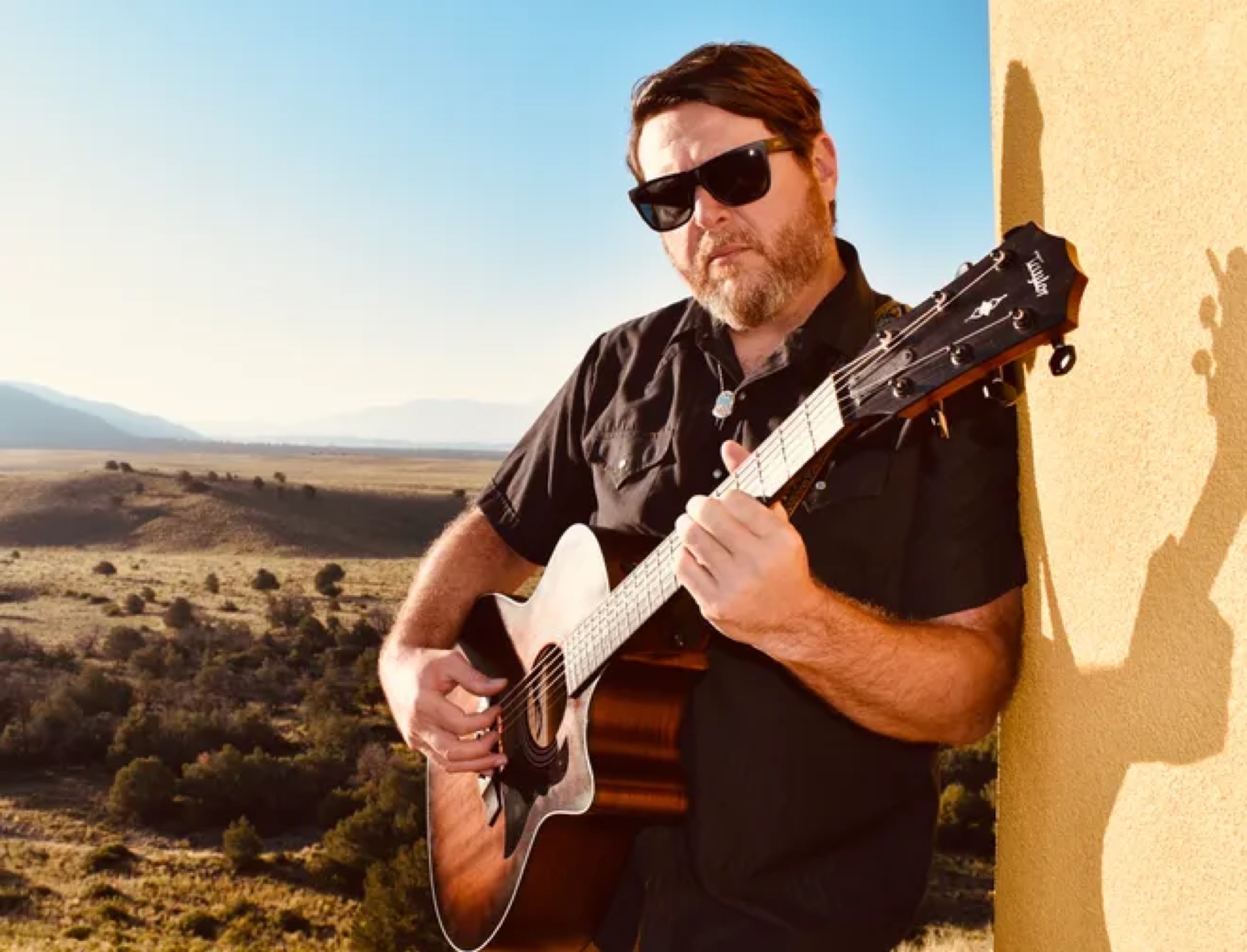
Some artists choose a familiar genre label. Desert Mind created a phrase for the particular territory its music occupies: Transcendental Desert Rock.
The Santa Fe, New Mexico, project combines alternative rock, Americana, melodic songwriting, rhythmic movement, and an atmospheric interest in nature and the cosmos. Its music is grounded in recognizable instruments and song structures, yet it repeatedly reaches toward questions that are harder to name.
What does it mean to move through the natural world with attention? How do memory and perception shape the stories people tell themselves? Can a rock song carry both physical weight and contemplative space?
Desert Mind’s work develops inside those questions.
A Santa Fe Collaboration
Desert Mind formed in 2022 and centers on two musicians with complementary responsibilities.
Antonio Dixon handles vocals, guitar, songwriting, composition, and much of the project’s studio work. Don Redondo contributes drums and bass, supplying the rhythmic foundation underneath Dixon’s writing.
This structure allows the project to exist in several forms. Desert Mind can perform as an acoustic duo or expand into a full-band presentation, adapting the scale of the music without abandoning its central identity.
That versatility is particularly valuable in the Southwest, where independent musicians may move between listening rooms, breweries, community events, theaters, outdoor stages, and larger regional bills. A project capable of changing its physical footprint can reach different audiences while preserving the emotional architecture of its songs.
What Is Transcendental Desert Rock?
Genre descriptions are useful when they help listeners find a door into unfamiliar music. They become limiting when they are treated as a complete explanation.
Desert Mind uses “Transcendental Desert Rock” to describe its particular combination of melodic alternative rock, Americana, atmosphere, rhythm, and philosophical exploration.
The term “desert rock” can carry several associations. It may suggest heavy guitar music, psychedelic repetition, open space, Southwestern imagery, or scenes connected to specific regions. Desert Mind’s addition of “transcendental” shifts the emphasis toward perception and inner experience.
Here, the desert is not merely scenery. It becomes a way of thinking about distance, scale, silence, time, exposure, and the relationship between human life and a much larger natural world.
The phrase does not eliminate the band’s alternative-rock or Americana foundations. It describes what Desert Mind wants to investigate through them.
Music Between the Ground and the Cosmos
Desert Mind’s songs repeatedly connect human experience with nature and the cosmos.
That combination can easily become abstract, but rock music supplies a physical counterweight. Drums create momentum. Guitar gives the songs texture and pressure. Melody offers a path through ideas that might otherwise remain distant.
This tension—between the grounded and the expansive—is central to the project.
The music can contemplate large subjects without completely leaving the body behind. A listener is invited to think, but also to feel rhythm, volume, repetition, and movement.
That balance helps explain why Desert Mind’s work can function in both acoustic and full-band settings. The quieter format exposes the songwriting and voice. The expanded arrangement gives the same material a broader physical and atmospheric presence.
A Catalog Built in Chapters
Desert Mind has developed quickly since forming.
Its second studio album, Flor, arrived in 2023. The song “Under the Stars” became a finalist in the Modern Rock category of the 2024 New Mexico Music Awards.
The third album, Under A Puzzled Sun, followed in December 2024. The record explores the human experience, nature, the cosmos, and the stories people use to understand their lives. It was subsequently named a finalist for Best Rock Album in the 2025 New Mexico Music Awards.
In June 2026, Desert Mind released its fourth album, Śūnyatā. The recording was completed in Santa Fe at A Cloud to a Dream Studio and Hopi Road Studio. Dixon engineered, mixed, and mastered the album while writing and arranging its songs; Redondo performed drums on selected tracks.
These releases show an artist treating albums as chapters rather than isolated uploads. Each record provides enough space to develop a set of related musical and philosophical ideas.
That commitment to the album format is meaningful at a time when musicians are frequently encouraged to build their entire release strategy around individual songs.
Śūnyatā and the Meaning of Emptiness
The title Śūnyatā comes from a philosophical concept commonly translated as emptiness.
In everyday English, emptiness can suggest absence or lack. In Buddhist thought, the concept carries a more complex meaning related to impermanence, interdependence, and the absence of a fixed, independent essence.
That distinction makes the word especially compatible with Desert Mind’s artistic interests.
A landscape may appear empty while holding complex systems of life. A person may experience identity as permanent even while changing from moment to moment. A song may seem to be a fixed recording, yet every listener encounters it through a different history and emotional state.
Desert Mind does not need to resolve those ideas into a lesson. Music can create a space where listeners experience a question before deciding what it means.
Recording as Part of the Artistic Identity
The creation of Śūnyatā also reveals the importance of independent recording practice to Desert Mind.
Dixon’s responsibilities extend beyond songwriting and performance into engineering, mixing, and mastering. That degree of involvement gives an artist unusually direct control over how the work moves from composition to finished recording.
Production decisions are never purely technical. The perceived distance of a voice, the weight of a drum, the width of a guitar, and the amount of silence allowed around an instrument all shape the listener’s interpretation.
For music concerned with atmosphere and contemplation, those decisions become especially important.
Independent production can be demanding because the artist must alternate between creative immersion and critical judgment. It can also make the final recording more closely reflect the internal world that inspired it.
Santa Fe Beyond the Familiar Image
Santa Fe is internationally associated with visual art, architecture, Indigenous and Hispanic cultural traditions, tourism, and an instantly recognizable regional aesthetic.
Its contemporary music community is more varied than that public image suggests.
Artists in Santa Fe create experimental music, hip-hop, punk, electronic work, folk, jazz, metal, alternative rock, and combinations that resist a simple category. They work within a city shaped by deep history while responding to the present.
Desert Mind contributes to that broader understanding.
The project’s music is connected to the landscape and culture of northern New Mexico, but it does not reduce the region to a backdrop. Its sense of place emerges through creative practice, collaboration, recording, performance, and sustained attention to the relationship between people and their surroundings.
Why Desert Mind Belongs in the Southwest Story
Desert Mind demonstrates how a regional artist can engage with place without turning place into a costume.
The project draws meaning from the desert, but its work is not limited to predictable Southwestern symbols. It uses the region as a starting point for thinking about consciousness, nature, time, connection, and change.
Its catalog also illustrates the value of patient artistic development. Albums create room for ideas to return in different forms. Acoustic and full-band performances reveal different dimensions of the same writing. Independent recording places technical craft inside the creative process.
The result is a body of work that feels grounded in Santa Fe while remaining open to listeners far beyond it.
Listen and Learn More
Visit Desert Mind’s official website to hear the band’s albums, explore its videos and photographs, and follow future performances.
The Desert Mind electronic press kit provides additional biography, music, performance information, press photographs, and contact details.
Desert Mind offers a useful invitation: listen closely enough to the world around you, and the apparent emptiness may begin to reveal how much it contains.