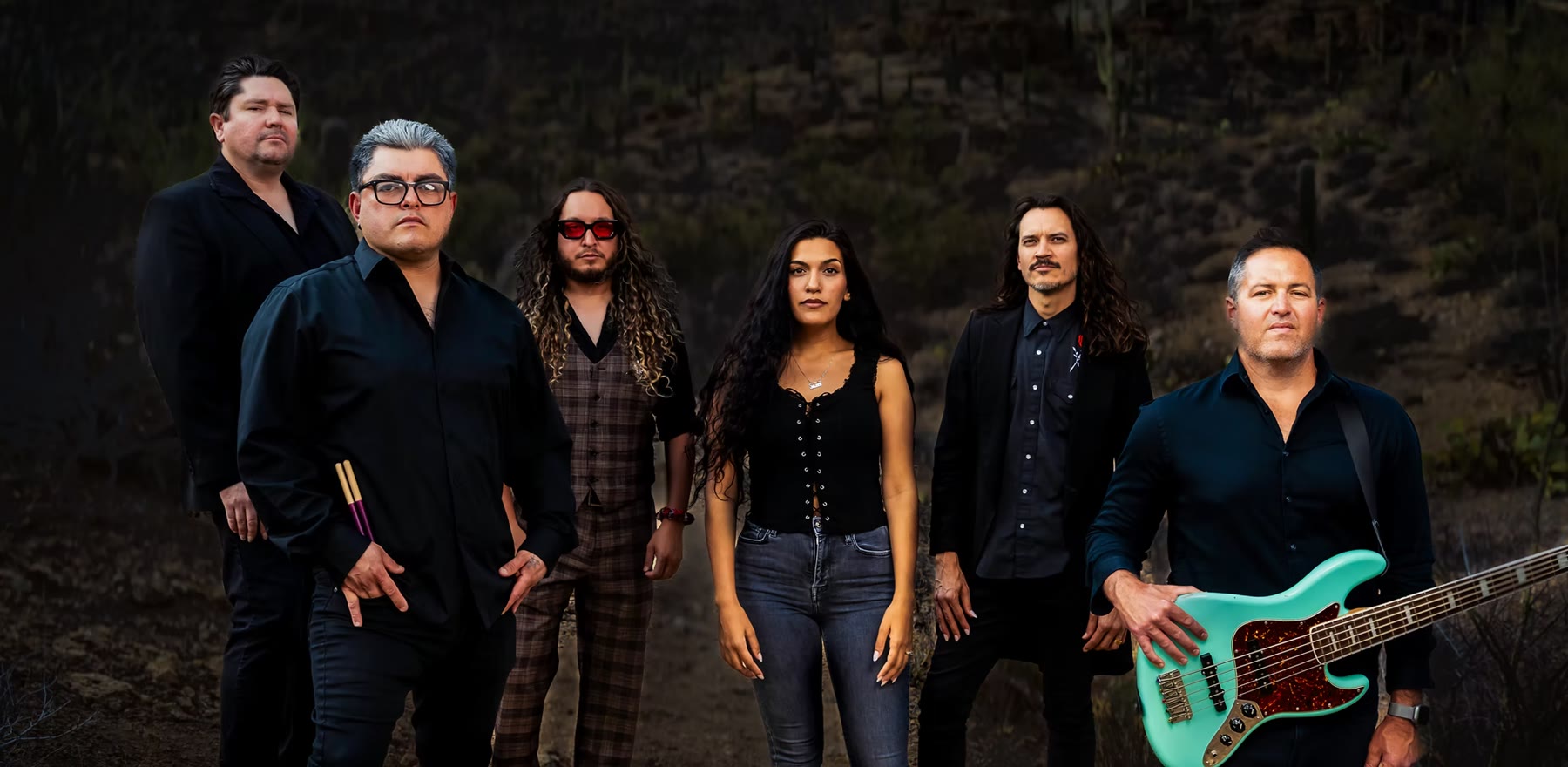
Some bands build their identity by fitting neatly inside a genre. Tesoro works through the tension between several of them.
The independent Arizona group describes its music as Latin Rumba Rock: a meeting of Spanish guitar, flamenco-influenced rhythm, rock energy, vocals, and cinematic arrangement. The name provides an entry point, but the music exists in the connections—between acoustic detail and amplified force, tradition and personal interpretation, intimacy and spectacle.
Tesoro’s story is also geographically layered. The group is currently based in Tucson, while its history includes meaningful roots in Phoenix and performances throughout Arizona. Tesoro does not represent a single city or a simplified regional sound. It demonstrates how artists build across the distances connecting Arizona’s music communities.
The Guitar Establishes the World
Spanish guitar sits near the center of Tesoro’s musical identity.
In this setting, the instrument does more than provide accompaniment. Its articulation, rhythm, and dynamic range establish the emotional and physical character of the music. A passage can feel intimate and exposed before the larger arrangement transforms it into something built for a full stage.
The group can move from stripped-down acoustic performance into a larger production carrying percussion, vocals, rock intensity, and visual drama. The guitar remains a recognizable thread even as the scale changes around it. This allows Tesoro to operate in several environments without abandoning its identity.
Fusion Requires More Than Addition
Musical fusion is often described as a list: take one genre, add another, and name the result. The real work is more difficult.
Different traditions carry their own rhythmic logic, instrumental language, histories, and expectations. Combining them successfully requires choices about which elements lead, which remain in conversation, and which should not be flattened into decoration.
Tesoro’s use of the phrase “Latin Rumba Rock” signals several points of connection. Spanish guitar and flamenco-influenced rhythm encounter the weight and momentum of rock performance. Cinematic arrangement adds another dimension, shaping how songs build tension, release it, and create a sense of movement.
The result is not interesting simply because it contains multiple influences. It becomes interesting when those influences alter one another.
Music Designed for a Stage
Tesoro’s official press materials emphasize live performance in both acoustic and full-production forms.
That distinction matters because the stage is not merely where recorded songs are reproduced. It is where scale, pacing, visual presentation, musicianship, and audience response become part of the composition.
A cinematic approach depends on contrast. Quiet passages give larger moments weight. Rhythmic sections create motion. Instrumental space allows tension to accumulate. Lighting, staging, and physical presence can extend what the arrangement already suggests.
Tesoro’s music is therefore best understood not only through genre but through experience. The songs are built to carry listeners through changes in intensity.
Ascension and an Expanding Sound
Tesoro’s recent album Ascension provides a focal point for the group’s current identity.
The band describes the record as a fusion of Latin rumba rock built from Spanish guitar melodies, flamenco rhythms, rock energy, and cinematic storytelling. The album title itself suggests movement: rising, changing, or entering another stage.
For an established independent band, a new album documents the current lineup and musical language, gives live performances a new center, and creates an opportunity to reconsider the relationship between earlier work and the direction ahead.
Between Phoenix and Tucson
Tesoro’s history connects two of Arizona’s largest music communities.
The band’s official account of its return to Phoenix describes the city as an important part of its earlier development. Performances throughout the Valley helped build an audience before the group’s focus shifted toward Tucson and regional touring.
That movement complicates the idea that every artist belongs to only one local scene. Musicians relocate. Lineups change. Audiences form in several cities. A band may develop in one place, find new creative energy in another, and continue carrying relationships between them.
The distance between Phoenix and Tucson is enough to produce distinctive scenes, but close enough for artists, listeners, promoters, and venues to remain connected. Tesoro embodies that corridor.
Independent Infrastructure Behind the Performance
A polished stage production depends on work the audience may never see.
Tesoro’s electronic press kit includes biographies, photographs, music, video, a press release, set information, technical and hospitality riders, management, and booking contacts. Those materials reveal an organized professional structure behind the performance.
An independent band must communicate clearly with venues, festivals, journalists, collaborators, and audiences. Good infrastructure does not replace strong music. It helps the music travel.
A Broader Picture of Arizona Music
Arizona music is frequently presented through narrow expectations. Some listeners anticipate country, folk, Indigenous tradition, border music, desert rock, or a visual language borrowed from Western mythology. Each can be part of the region, but none can represent it alone.
Tesoro expands that picture. The band’s music connects regional experience with Spanish guitar, Latin rhythm, rock performance, and cinematic ambition. Its identity is recognizably Southwestern without treating the Southwest as a costume.
Regional identity is strongest when it emerges through lived relationships, movement, community, and artistic practice—not when scenery is used as a substitute for substance.
What Tesoro’s Story Reveals
- How musicians build audiences between Phoenix and Tucson
- What happens when acoustic traditions enter amplified rock arrangements
- How a regional band creates a professional touring structure independently
- What makes musical fusion feel integrated instead of ornamental
- How live production influences the way music is composed and remembered
- How an Arizona artist can sound connected to place without being confined by it
A Sound Built Through Connection
Tesoro’s music lives at a crossroads.
Spanish guitar meets the physical momentum of rock. Intimate performance expands into theatrical scale. Phoenix history meets a Tucson-based present. Regional identity connects with musical traditions extending far beyond Arizona.
The band’s strength does not come from resolving those relationships into one simple category. It comes from keeping them active. Tesoro builds through connection—and turns those connections into a live musical world.
Listen and Learn More
Visit Tesoro’s official website to hear current music and follow performances. The band’s electronic press kit includes its biography, downloadable high-resolution photographs, videos, press information, and professional contacts.
Continue exploring the region through Southwest Sound Waves’ Tucson and Phoenix coverage.